Development, Sales and Marketing of Electronic Products
Road Map for Marketing
Before we start on our way and use a road map, it would be a good idea to learn the destination. What is the goal of a marketer and of Marketing? I like the following goals, that I took from a book on marketing. (Marketing Management by Philip Kotler).
The goal of a marketer is to maximize the satisfaction of the customer. Finally, the enlightened marketer helps to optimize the quality of life.
The goal of marketing is to define an organization's products, services, prices, communication and distribution in such a way that they satisfy real customer needs. In order to satisfy customer needs, marketing integrates numerous functions that influence customer satisfaction, like sales, advertisement, marketing research, development of new products, support and the physical distribution.
In some of these functions marketing plays a leading role, like in marketing research. In other functions marketing plays a serving role, like in many sales situations. (This probably comes from the fact that many sales people are excellent marketers.)
The following illustration makes it easier to understand how these functions interact.
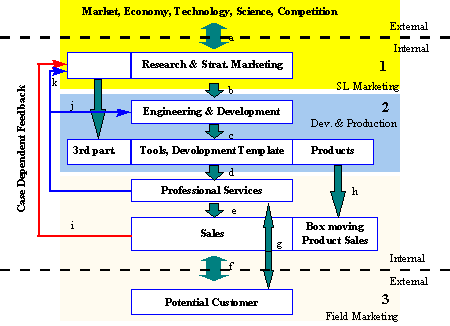
The market, economy, technology, science and competition have the answer for our successful business. Strategic Marketing and Research needs to interact strongly with this external world (see arrow marked a) to get the input required for Engineering & Development (b).
The output (c) are tools and development templates (= good developed application that do need only little customization). If you want than you could rename this box, Production.
These tools and templates serve Professional Services to develop their customized applications.
Sales can take these applications (e) and offers them a potential customer (f) to help him to solve his problem.
Not only Sales interacts with the customer, but also Profession Services (g).
Some of the offerings are shrink wrapped products and can be sold like moving boxes (h).
Strategic Marketing can fill the box of tools and products with suitable offerings from third parties (j).
If Sales is missing tools or applications to do their job successfully they give feed-back to Strategic Marketing (I).
This feed back will nearly always be initiated by a certain project and is therefore case dependent. Professional Service is technical enough that certain feedback goes directly to Development (j), and/or to Strategic Marketing (k).
Sales vs. Marketing Concept
If an organization is driven by short term goals, it cannot use a marketing concept but needs a sales concept.
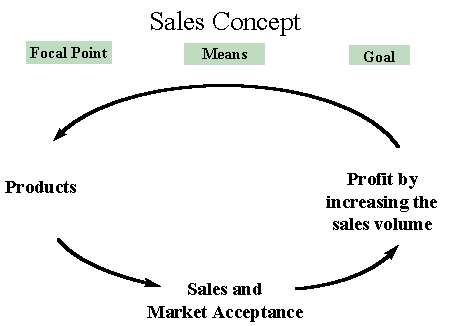
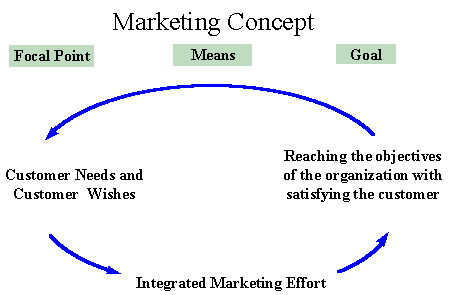
A better marketing concept is to find needs and fulfill them and not to invent products and sell them. This is illustrated by the following marketing concept.
Most of the ideas come from discussion with Hansruedi Kottmann, former VP Europe ( MDL) and Alexander Kos
12.12.1996
Product vs. Project
| No substantial part of the universe is so simple that it can be
grasped and controlled without abstraction. Abstraction consists in
replacing part of the universe by a model of similar but simple structure.
Models… are thus a central necessity of scientific procedure.
Arturo Rosenblueth and Norbert Wiener |
The purpose of this document is to illustrate how products and projects are related to gain a clear understanding where and how Marketing has to leverage its efforts.
What is a product? Here is one definition from a marketing book: "Everything is a product, which can be offered to a market to get attention, can be bought or used for consumption. The definition of product encompasses concrete things, services, people, locations, organizations and ideas."
What is a project? Something devised in mind. According to these definitions a project can be a product. This makes it so difficult to try to distinguish.
The abstraction of the development processes in which product and project play a role might help us further.
Let's look at a schematic presentation of the Product Development Cycle.
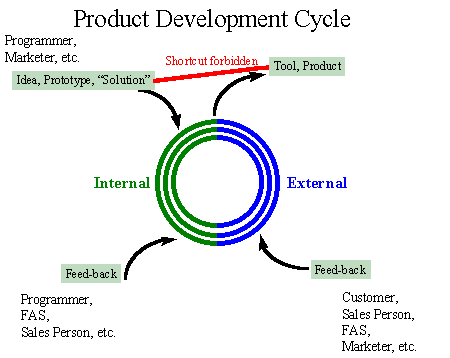
Strategic Marketing develops an idea. This idea is discussed internally. Maybe, a prototype will be developed to illustrate the idea. Marketing and Sales will give feed-back and will collect feed-back in the field. Probably one has to go several times through the loop until one has a product description that will be accepted by the customer. Development than runs his development cycle until the product can be released.
The past has shown that it does not pay to shortcut this cycle and forfeit the feed-back from internal and external resources. I am sure everybody, who developed a product thought that he went around the cycle and did not shortcut.
This means we have an inherent problem, if we rely on this product development cycle.
Let's have a look how a "Solution" Development Cycle looks like:
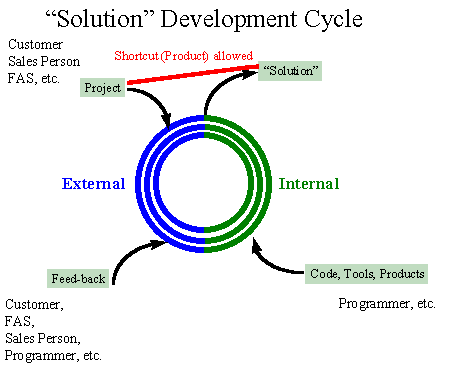
The customer and sales define a critical business issues (cbi) and have a vision how to solve this issue. A project is borne. The customer has to verify his ideas with other people of his company and involves his personal to develop the feasibility study and all the other parts that are required until a final system design is written. Then, a programmer puts code, tools and products together for the final "solution". ( We know that we do not have solutions. The customer, only he can solve his problem.)
If we have a product that helps to solve the customer's cbi directly, then we do not have to go through the cycle and can offer the "solution".
As we have seen above the Product Development Cycle has an inherent shortcoming. Maybe, we can overcome this by combining both of these cycles.
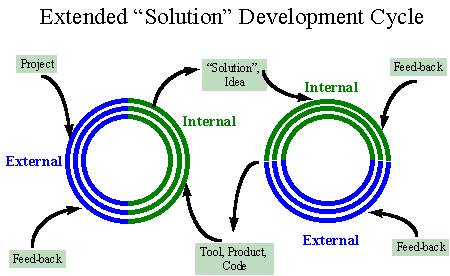
We probably have more success in product development if we use the "Solution" spiced with a few own ideas as input for the Product Development Cycle.
What have we learned?
- We do not sell products, we only sell projects.
- We do not develop products without having realized at least one "solution" with the involvement of the customers.
- Product knowledge must be extremely high at the programmer's side. He is using mainly the products.
- Sales persons and technical support persons must have a strategic knowledge of our capability to help the customer in building visions of the "Solution".
Can we use these schematics to derive at a procedure how to market and sell a project that is general?
Find customer need (CBI = critical business issue) and turning
latent pain into acute pain
The sales process is an easy one for the sales person, once a customer has admitted to a CBI. This is where Solution Selling® starts. The problem is how to get the customer to admit to his CBI. If you are lucky, the customer tells you his needs and asks you to develop his project.
Normally, you have to help a little bit. For this you need to have excellent business knowledge.
Sales people are close to the customers and need good business knowledge as prerequisite of doing a good sales job. Marketing has the task of providing this business knowledge. This can be done by providing
- background material
- suggesting important events for the sales people to participate
- helping to organize high level meetings (i.e. a person running a company has a better business knowledge than a lab chemist. Top managers have to make sure that they involve sales people, when they meet other high level managers. Marketing can play here an organizing role.
What worked in the past?
Some people claim advertisements helped. It is very difficult to say which one was a successful advertisement and which one was not. The real problem is that it is difficult to do the next advertisement in such a way that you are sure it is successful.
What seemed to work repeatedly are presentation of solutions. The ingredients for a successful presentation of a solution are:
- Present the background of the problem. The audience must understand the situation, and if possible has to identify itself with this situation. Sometimes this requires a lot of technical know-how, scientific know-how and business knowledge. Since this know-how is often not combined in one person several specialist have to work together in a team.
- Interdependence of CBIs and reasons. The audience is always mixed. Nevertheless are the people all influenced by the same problem. It helps, if the audience can understand that each CBI has a reason and that each reason can be a CBI. Only by explaining this interdependence, will it be clear to the research director that combining biology and chemistry on the computer screen helps to increase the stock price.
- Presentation of the solution. Instead of talking about the solution one should show the solution. Normally a desktop demonstration is enough to illustrate how the CBI can be solved. This demonstration will concentrate on the solution and we do not talk about a product. Your fingers will fly over the keyboard, now is not the time to show features.
- Presentation skills. If the presentation does not work well, then you do not illustrate a solution but a problem. Nobody will identify itself with such a presentation.
These presentations are often done by the sales people themselves. Marketing has to provide the material and background information so the sales person will give a skilled presentation. Often enough these presentations are given by people from the marketing organization.
These presentations are given at customer sites, events, and road shows.
Personal discussions with the customer trying to understand sincerely his business has probably helped most often to define the CBI. These discussions are mainly between customer and sales person. Marketing can only help to train the sales person.
Sometimes it is really difficult to unearth the customer's needs. Market research is needed to formulate a CBI.
Implementing a "Solution"
Only after one has implemented successfully a "solution" for the customer, one has truly understood the problem. One knows who are the people who are involved. It becomes clear how to position such a "solution, and it is easy to describe the situation in which the "solution" works. Such a "solution" can lead to a new product. Marketing has to be involved to understand the "solution" and has to help making it a reality by helping to remove all the "dead wood" that is produced.
- Empty promises, that are not followed up
- Address changes, that nobody ever changes
- Bug and enhancement request that nobody ever reads
- "Great" Meetings with no outcome and no follow-up
Reselling the "Solution"
What has worked for one customer should normally work for other customers. Now, we can treat a "solution" like a product and all these tasks have to be done.
- Provide technical and scientific background
- Show examples how people are involved
- Document their CBIs
- Description of our plans
- Prepare the pricing
- Provide solution oriented demonstrations
- Collateral
- White paper
- Provide information resource
- Give quick responses
This all can help the sales person to find the new project. The cycle starts again.
(Thanks to Kara Andrews for suggestions)
Alexander Kos
9.12.1996
( Solution Selling: Creating Buyers in Difficult Selling Markets, Michael T. Bosworth, IRWIN Professional Publishing, Burr Ridge, Illinois, 1995, ISBN 0-7863-0315-8, contact C. Durham at SPI (Sales Performance International - www.solutionselling.com).
|
|